


The .md Files Based Company: How AI Handles Work Too Rare to Automate
Tenders, partner CVs, conference stands, contracts and onboarding happen too rarely to automate – but when they happen, they are intense. A handful of .md files with company context makes AI useful for all of them.


Before AI, there were many tasks that were too occasional to be automated. But when they happened, they were intense.
How can AI draft a tender proposal that sounds like your company?
Typical examples come from sales. For example, proposals for sales tenders. We are a B2B company, so proposals don’t fit a page or two. Typically there will be tens of pages - and I know examples with over hundred. There is always plenty to copy paste from previous proposals, but also plenty to write from scratch. Mostly when it comes to project specifics and of course, financial estimates.
Financial estimates are always a nightmare per se. Too big a price, you risk losing the deal. Too little, and you risk losing your own money if you win the deal.
Nowadays AI can be a great help to confirm or challenge your estimate. Sometimes it will really remind you of a task you genuinely forgot. But you don’t want to type into AI the same context every time. Company profile, business model, standard prices.
The solution? MD files. By using desktop versions of main AI vendors, such as Anthropic or Open AI, you can organize your work into Projects. If the project is about writing proposals, you can upload everything there - company profile, proposal template, rules and guidelines, historical examples. As a result, you get tens of pages of proposals in just a prompt or two. It can even help you with the estimate at hand.
How do you get partner CVs into your corporate format without losing a day to reformatting?
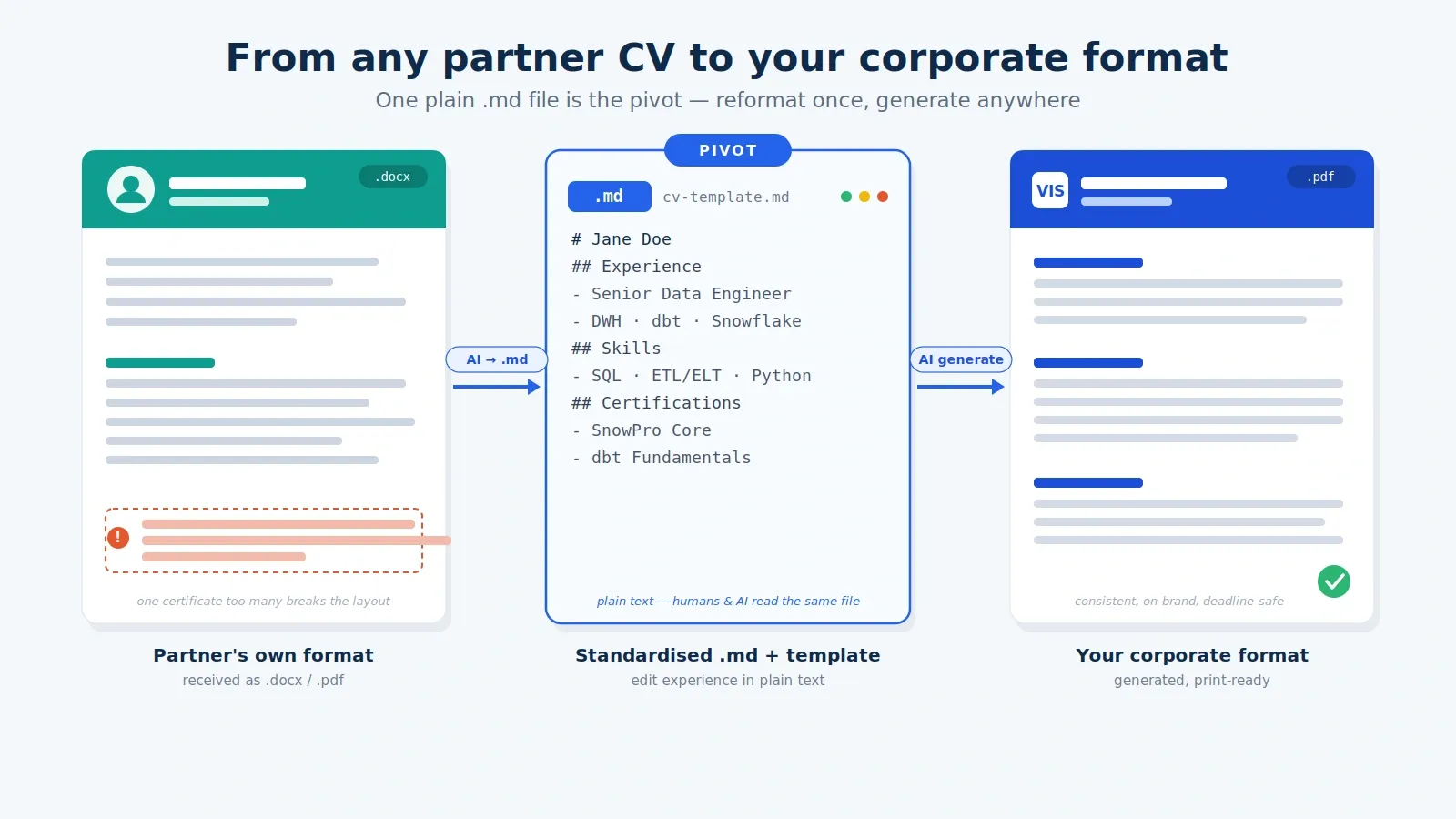
If we had to attach CVs to the proposal, the situation would get even worse. You always need one or two roles you don’t have, so you subcontract a trusted partner. You receive the CVs for the roles in, well, partner’s format. Marketing spends about half a day to a full day just creating CV versions in our own format. It would probably be faster if “one certificate too many” didn’t break the formatting of the whole document. Then sales takes over and fine tunes CVs, our own and partner’s, for the need of the tender in hand. Subtly stress out the skills and experience needed, kick out everything else. Newest projects are always missing, so add that too. More hours pass, and you risk missing the deadlines that are always super short for CV submissions. In reality you usually meet the deadlines - thanks to overtime and a bit of extra stress.
Solution? MD files. Use AI to transfer all the CVs in standard .md template. Fine tune experience directly in .md if needed. Then tell AI to generate all the CVs in corporate format. Less overtime, more responsive and professional output.
Can AI fill in grant applications, client questionnaires and contract reviews?
Tenders are not the only paperwork that comes in bursts. Each now and then you need to fill out a bunch of random forms. A subsidy or grant application. A loan application for the bank. A questionnaire from your key account.
They all have one thing in common – sections asking for company data. Founding date, last year’s financial results and the like. With a company profile in .md, AI answers those sections straight from the profile. We do it regularly, and honestly, it is super easy. Easier than agentic coding, for sure.
Questionnaires from large clients are a similar story. With proper context, AI can answer the greater part of them.
What rules does AI need before it can review a contract?
Contract review goes one step further. Here the company profile is not enough – AI needs rules too. What to look for? Penalty clauses. SLA sections. Intellectual property details. Put those rules in an .md file, and AI checks every contract against the same list. We already review our contracts with the help of AI.
How do context files keep a conference stand, a founder and a website on one message?
But using agentic AI, even in such simplest form, can do much more than just help generate documents of all sorts.
Take marketing events, such as conferences, for example. Sponsoring events can be an absolutely great way to generate leads, even genuine business opportunities. But events can also be an expensive flop. Lets face it - we’ve all been there at one point or another.
Organizing a team, stand, visuals, tagline, brochures, goodies, lead generation mechanisms - it’s a lot of work. One major mistake, and you get a flop. Even if you organize everything properly and are passive when you get there - still a flop.
How to make sure that everything gets organized spotlessly, so the team can focus on what you came for - selling your stuff?
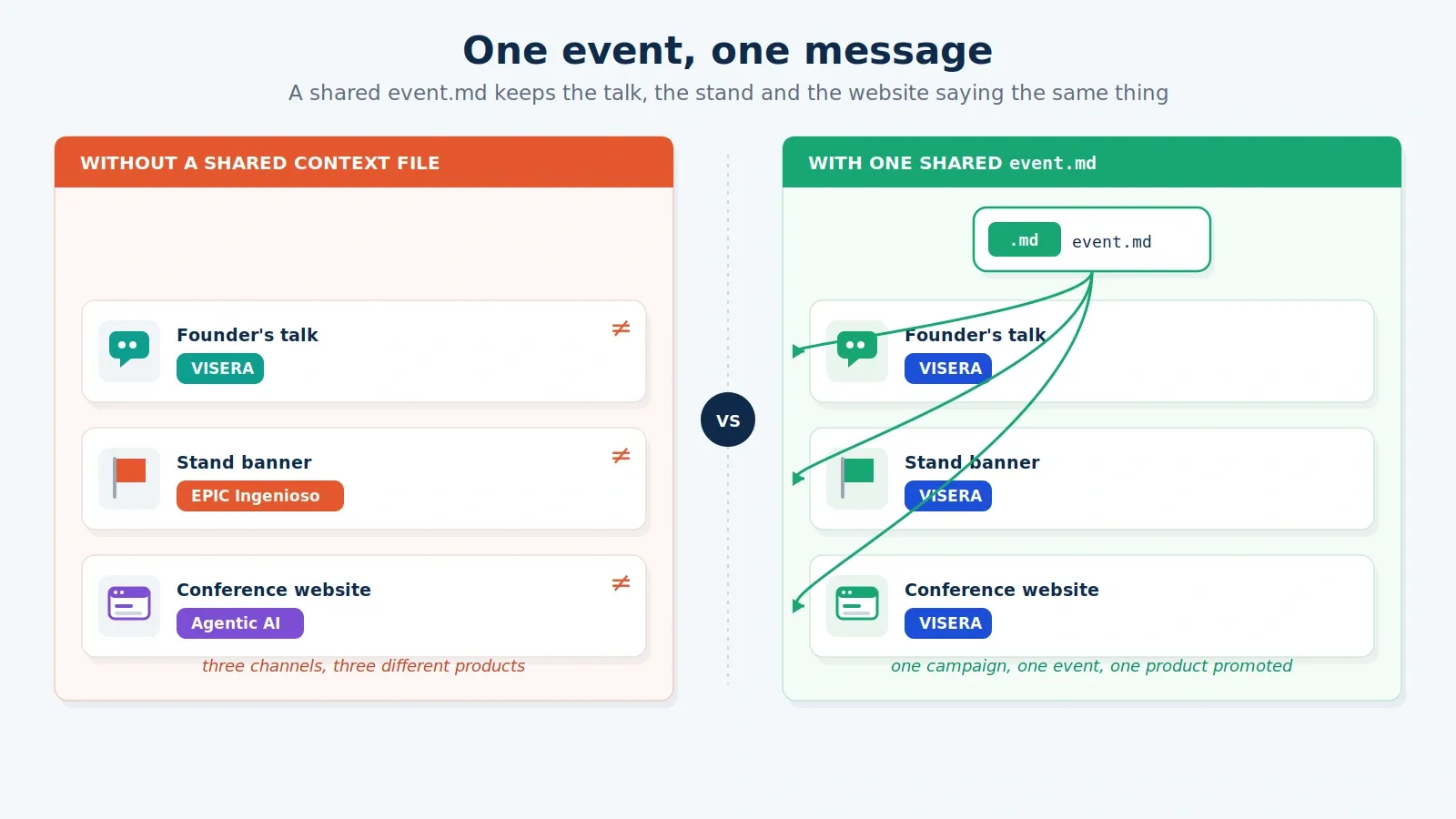
You already know the answer by now - md files. Put there all the guidelines, goals, up-to-date marketing communication, check list templates and best practices. You can even put marketing materials there - AI can help you with designing stand backgrounds or brochures. Most importantly - thanks to md files, AI knows what we came for. No more examples where I talk about one product, the stand promotes another and the company profile on the conference website talks about non-related services. It almost happened to us at one of the events where we exhibited. And the story from my example happened exactly because AI was used to help create text - just without proper and consistent context. We noticed it in time and corrected it. Had our rules already been in .md files, I believe it could have been avoided altogether.
If you use projects in Claude or ChatGPT desktop, this won’t happen. One campaign, one event, one product promoted.
Once all the wisdom and rules of events are in md format, you can use it in many forms. You can print out absolutely beautiful cookbooks for new employees in marketing. If something is unclear or gets forgotten, employees can chat about it. But most importantly, you can now use AI in absolutely every step of the process, being sure it will get the things right.
What could an AI take over at an event next?
We haven’t done it yet - but I firmly believe that we can take it even one step further. Using AI to help us organize our own events, which is an order of magnitude more complex than exhibiting. And exhibiting IS complex, don’t get me wrong.
Or even more fun - giving AI to try to prepare an event autonomously. Adapt the stand background for the event’s concrete dimensions, order goodies, order printing more brochures if needed, fill out the forms, and communicate with the organizers.
When we try that out, I’ll let you know. My intuition tells me that machines might soon become more reliable in that activity than many humans. But validating the output will always be on me. It is still my company and my responsibility.
How do you onboard data engineers consistently instead of one mentor at a time?
Onboarding is another one of those occasional but intense tasks. In our case, mostly onboarding Data Engineers.
Before, new hires were mentored by seniors on real projects. It was exhausting for the seniors. And it was not consistent either – whatever the project didn’t need, the new hire simply skipped. Try comparing two candidates who learned two different things.
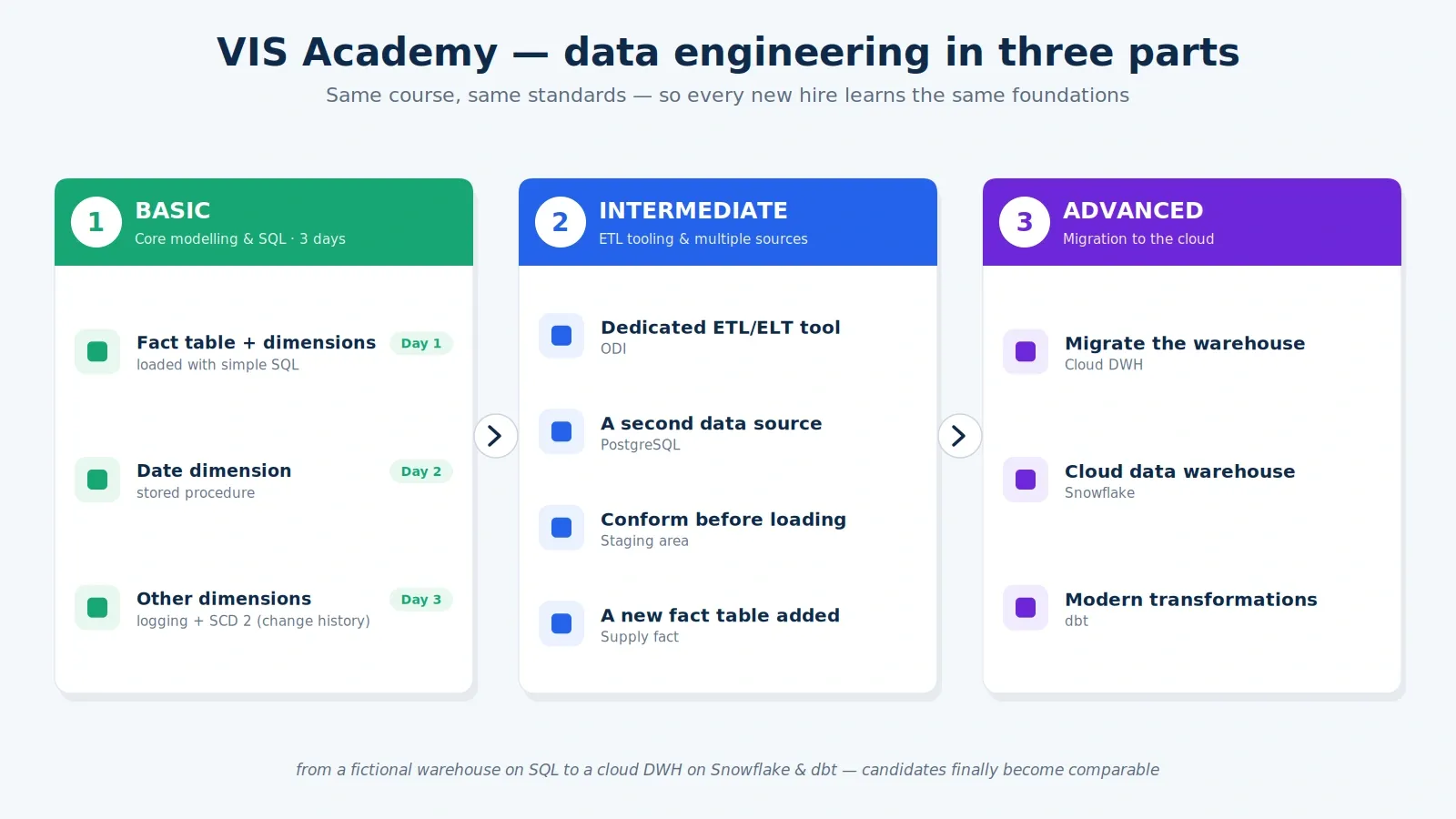
So we built VIS Academy. A data engineering course in three parts, designed to make sure everybody knows the basic concepts and uses the same development standards and frameworks.
The basic part lasts three days. On the first day, the candidate models a fact table with its dimensions on a fictional example, and loads the data from the source system using simple SQL. On the second day, they program a stored procedure to load the date dimension. On the third day, they develop proper stored procedures for the other dimensions – including logging and SCD 2, the technique that keeps the history of changes in a dimension.
The intermediate part introduces dedicated ETL / ELT tools such as ODI, and multiple data sources. Sales data from the basic part gets conformed with supply data coming from a different source, on a different technology – PostgreSQL. The candidate learns the staging area concept, where the data sits in the same technology before being conformed into the same dimension tables. A new fact table for supply is added too.
The advanced part moves to the cloud. The candidate migrates their fictional data warehouse to a cloud DWH, using modern technologies such as Snowflake and dbt.
Every new hire went through it, regardless of seniority. Even experienced candidates were expected to follow our development standards and close the gaps in their knowledge.
Who checks a trainee's work when the seniors are busy?
And who checked all that work? Not the seniors.
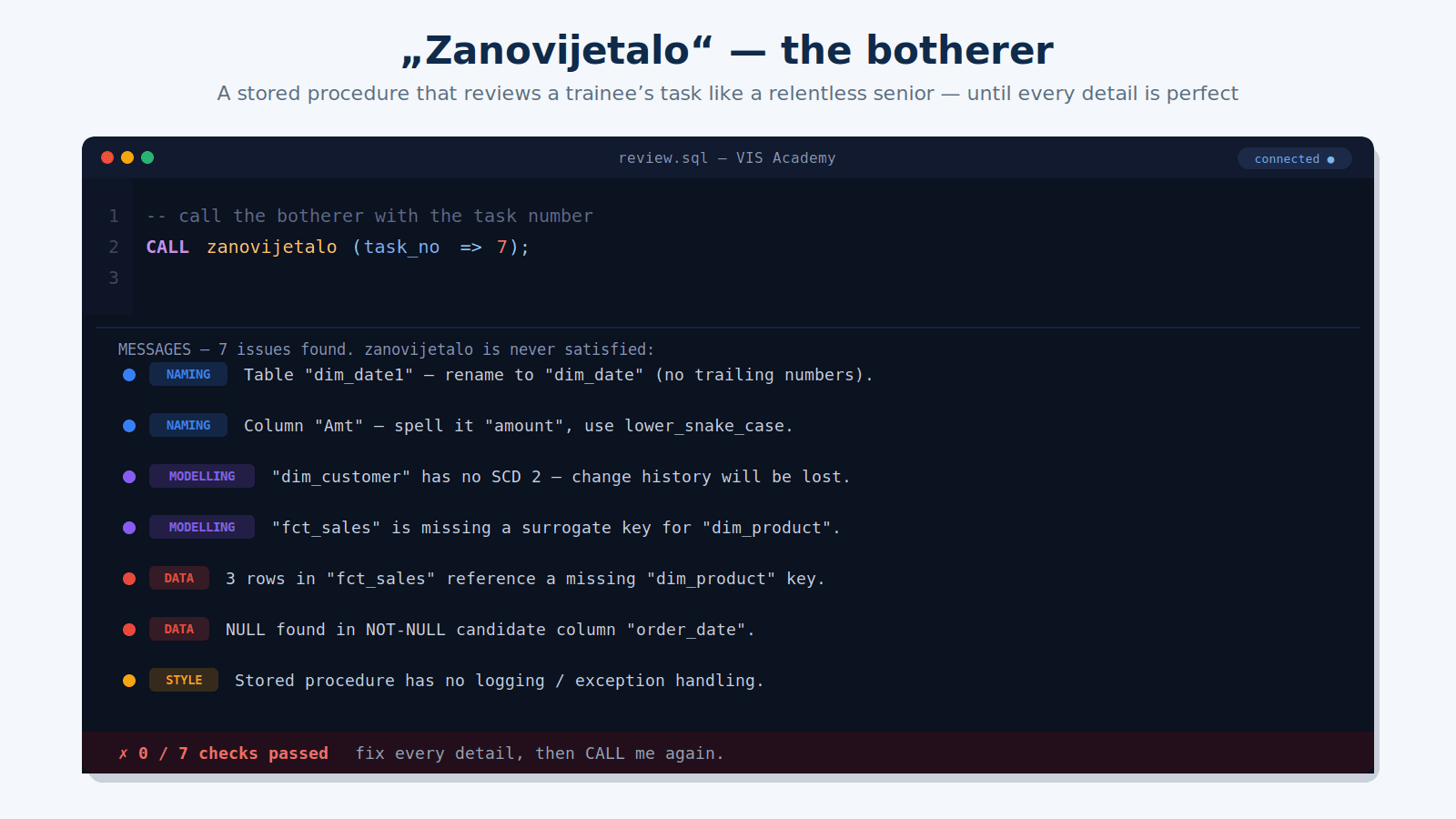
We built an evaluation algorithm and called it “zanovijetalo” – roughly translated, the botherer. It was a stored procedure the candidate called in the same SQL editor, with the task number as a parameter. It simulated a super meticulous boss who kept bothering you until every detail was perfect. Naming. Physical modelling standards. And of course – correct data.
We don’t have hard numbers. But the academy definitely reduced the mentoring effort for seniors and got new people onto real projects faster. And since everybody took the same course and the same tests, candidates finally became easy to compare.
What does agentic coding change about training data engineers?
Then agentic coding arrived, and our academy started getting obsolete. Fast.
The course was built around coding skills, DWH modelling and basic ETL concepts. Today the accent is less and less on coding – you replace coding with prompting. But understanding the core concepts is more crucial than ever. Without it, you can’t point the agent in the right direction.
So we will soon start rebuilding VIS Academy. In the new version, candidates will develop the code using Claude Code or OpenAI Codex rather than writing it by hand.
What about the .md files? You might expect us to hand the candidates our development standards as ready-made context for the agent. We won’t. The requirements are already listed in the fictional project they work on. Turning those requirements into context the agent can follow is exactly the skill we want to develop. Satisfying requirements is still the job. Only the way you do it has changed.
We will use .md files ourselves, though. The course – the fictional company, the tasks, the source systems – will live in .md, so AI can help us generate fresh task variants and keep the material current. And the botherer gets an upgrade. It will stay just as meticulous, but instead of only saying what failed, it will explain why.
Testing the end results will stay strict. Proper naming and readability, for humans as well as machines. Good practices such as logging, exception handling or SCD 2 where needed. People will perhaps not need to write code anymore. But they will need to understand what they are doing – to build reliable, fast and highly accurate solutions, the kind we have historically been proud of.
Which .md files should a company actually keep?
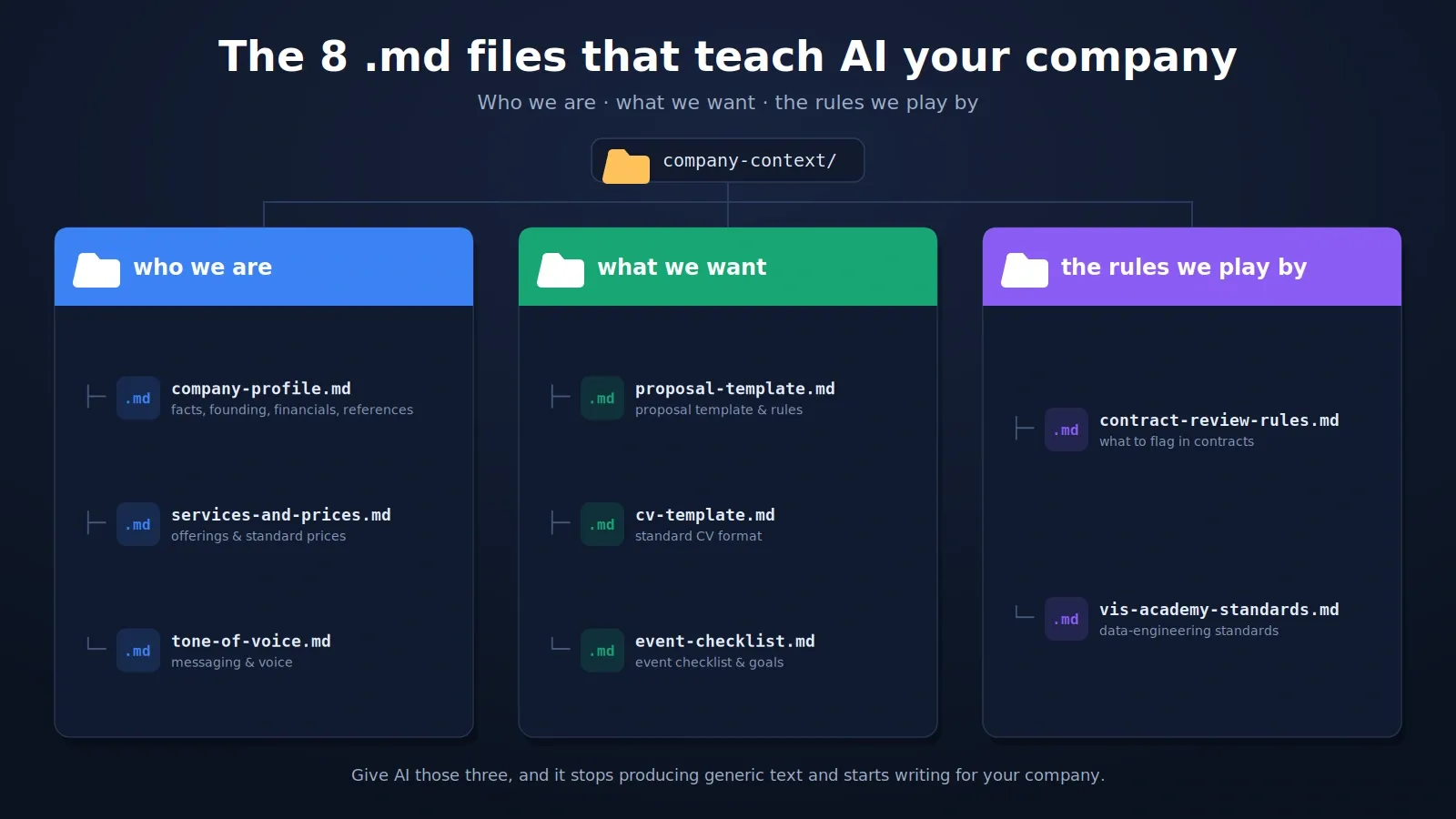
So which .md files should a company like ours keep? Here is the list we are working towards:
- Company profile – facts, founding date, financial results, references
- Services and standard prices
- Tone of voice and messaging
- Proposal template and rules
- CV template
- Event checklist and goals
- Contract review rules
- VIS Academy standards
The pattern is always the same. Who we are, what we want, and the rules we play by. Give AI those three, and it stops producing generic text. It starts producing text for your company. Call it AI workflow automation for the work that never had a workflow.
None of it is rocket science. Most of it already exists somewhere – in old proposals, in emails, in people’s heads. The work is putting it in one place, in a format both humans and AI can read.
Occasional tasks: handled by hand versus handled with AI and company context files
| Occasional task | By hand | With AI plus .md context |
|---|---|---|
| Tender proposal | Tens of pages copied, rewritten and priced from scratch | Tens of pages drafted in a prompt or two, estimate challenged |
| Partner CVs | Most of a working day of reformatting, then sales rewrites | CVs standardised in markdown, regenerated in corporate format |
| Grant and loan forms | Company data hunted down every time | Answered straight from the company profile |
| Contract review | Different reviewer, different checklist | Every contract checked against the same rules file |
| Conference stand | Message drifts between founder, stand and website | One campaign, one event, one product promoted |
| Onboarding | Ad hoc mentoring, candidates hard to compare | Same course, same standards, automated checking |
Where should you start on Monday?
You almost certainly have one of these tasks too. The tender proposal that means overtime. The questionnaire nobody wants to fill out. The new hire nobody has time for.
Start on Monday with one thing. Write a one-page company profile in .md. Then set up a single project in Claude or ChatGPT for your most painful occasional task, and upload the profile there. You will see the difference quickly.
In December we close the series with the grand finale – how AI agents transformed our company. All the bricks from this series, from accounting and travel expenses to support and coding agents, put together into one highly automated, intelligent company. Subscribe to our newsletter so you don’t miss it.
Frequently asked questions
Answers to the most frequently asked questions.
It is a plain markdown document holding one piece of company context — the profile, the price list, the proposal rules — that both people and AI can read. Pasting the same company profile, business model and standard prices into every new conversation is exactly the work this removes. Most of the content already exists in old proposals, emails and people's heads; the job is putting it in one place in a readable format.
For these occasional tasks, the desktop versions of the main AI vendors are enough: you organise work into a project and upload the company profile, templates, rules and historical examples once. We answer the company-data sections of grant applications and loan forms this way regularly, and honestly, it is easier than agentic coding. Custom Intelligent Automation earns its place on high-volume processes, not on an occasional form.
We do. Context files make the output specific to the company rather than generic, but validating a price, a contract comment or a public message is still a human decision — in our case mine, because it is my company and my responsibility.
At VIS, yes — every new hire went through VIS Academy regardless of seniority. Experienced candidates are still expected to follow our development standards and close whatever gaps they have, and because everyone takes the same course and the same tests, candidates become directly comparable.
The ones that arrive in bursts and demand company facts under deadline: tender proposals and the CVs attached to them, subsidy and grant applications, bank loan applications, key-account questionnaires, contract review, conference stands and onboarding. They all ask for the same core material — founding date, financial results, references, services, prices, tone of voice — and they all suffer when somebody has to reassemble it from scratch at speed.
Tags
You might also be interested in
View all articles BLOG

 BLOG
Support Automation Tips & Tricks
 Miljenko Vuković
 BLOG
The Event Agent That Never Books Anything
Miljenko Vuković